Science and Space
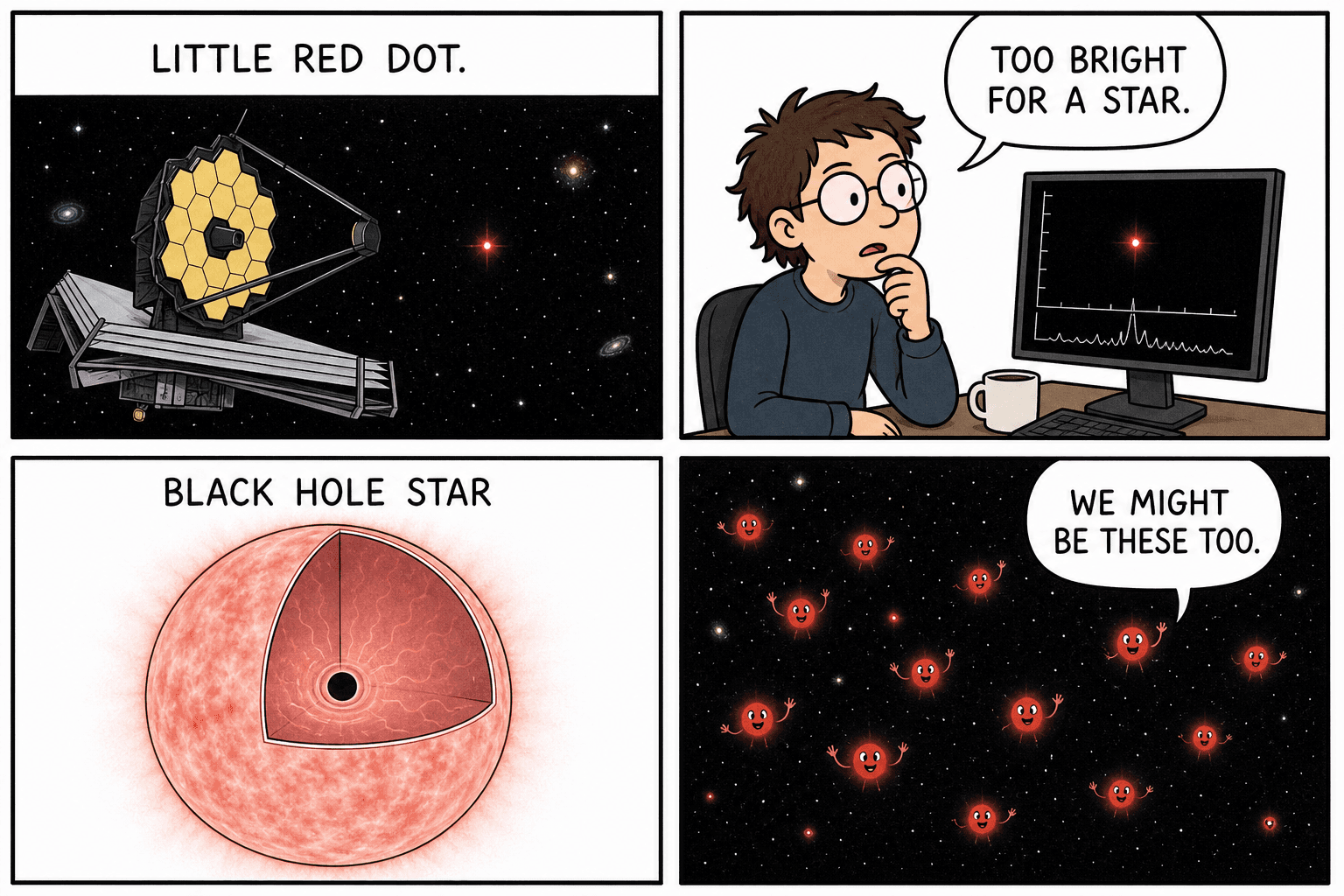
A “black hole star” may explain JWST’s little red dots
Astronomers using the James Webb Space Telescope have spotted an extremely bright red object in the early universe and argue it is a new kind of source: a “black hole star.” The object looks something like a star the size of our solar system, but it pours out about 100 billion times more energy than any known star can make with nuclear fusion.
The team, led by MIT Hubble and Pappalardo Fellow Rohan Naidu, published the analysis in Nature on Aug. 12, 2026. JWST found the red dot when the universe was only a few hundred million years old. The researchers say the most likely picture is a dense hydrogen envelope powered by a central black hole, not by fusion in a normal stellar core.
Naidu’s group was not hunting for a new object class. They were running a survey they nicknamed “Mirage or Miracle,” looking for the earliest real galaxies. Some of the brightest early “galaxies” may be mirages. This particular source stood out as very red and very bright.
Red light in astronomy often means dust. Other signatures in this object’s light did not match ordinary dust. The spectrum was extremely bright except below certain wavelengths, where the light vanished. That drop is a Balmer break. Naidu said this was the deepest break they had ever seen in any object, which rules out ordinary stars.
The light also showed almost no metals, only hydrogen and helium. Simulations asked whether you could make something that red with hydrogen alone, no dust. The answer was yes, if the hydrogen is so dense it looks more like the surface of an enormous star than a thin nebula. Fusion cannot power something 100 billion times brighter than a star.
Black holes can. The team added an accreting black hole inside the hydrogen cocoon. The best fit is a black hole about 100,000 times the mass of the Sun, wrapped in a solar-system-sized envelope of dense hydrogen. They named the object MoM-BH*-1.
Little red dots show up in nearly every deep JWST image of the early universe and mostly vanish by the present day. Naidu says every little red dot is consistent with being a black hole star sitting in a generic early galaxy. MIT Kavli’s Robert Simcoe and undergraduate Wendy Sun are among the MIT co-authors.
Paper: Naidu et al., Nature, Aug. 12, 2026.
Source: MIT Kavli / MIT News